Blog Archive

Saturday, January 29, 2022

Hypocrites – 29 January 2022, Anno Domini


A

N hypocrite with his mouth destroyeth his neighbour: but through knowledge shall the just be delivered. (Prov 11:9)


A

ND why beholdest thou the mote that is in thy brother's eye, but perceivest not the beam that is in thine own eye? 42 Either how canst thou say to thy brother, Brother, let me pull out the mote that is in thine eye, when thou thyself beholdest not the beam that is in thine own eye? Thou hypocrite, cast out first the beam out of thine own eye, and then shalt thou see clearly to pull out the mote that is in thy brother's eye.     (Luke 6:41-42)


T

HOU hypocrite, doth not each one of you on the sabbath loose his ox or his ass from the stall, and lead him away to watering? And ought not this woman, being a daughter of Abraham, whom Satan hath bound, lo, these eighteen years, be loosed from this bond on the sabbath day?”        (Luke 13:15-16)


            The Lord Jesus Christ did not practice ‘political correctness’ and neither should we. He called a spade, a spade; and false professor a hypocrite! The etymology of common words and terms can be quite enlightening. For example, what is the etymology of the term ‘Good Bye’ so commonly spoken in the English language? It may surprise you! From the ‘Online Etymology Dictionary, we learn the derivation of “good bye:’


Good-bye  a salutation in parting, also goodbye, good bye, good-by, 1590s, from godbwye (1570s), a contraction of God be with ye (late 14c.), Intermediate forms in 16c. include God be wy you, God b'uy. The Spanish meaning is more articulate today: Vaya con Dios! (God go, or, be) with you! So, why not eliminate the abbreviation and just say, God be with you, instead of Good bye?


            In examining the word, hypocrite, we learn that it, too, has a meaningful history:

Hypocrite (n.)

            c. 1200, ypocrite, "false pretender to virtue or religion," from Old French ypocrite (12c., Modern French hypocrite), from Church Latin hypocrita "a hypocrite," from Greek hypokritēs "stage actor; pretender, dissembler," from hypokrinesthai 


            In the Mediterranean world of the time of Christ, Greek was the ‘lingua franc’ of the civilized world. So, the term hypocrite, as used by our Lord, referred to the play-acting hypocrites of false religious legalism.


            A fable of Aesop reveals a wonderful example of the hypocrite and his reward:


The Wolf in Sheep's Clothing

A wolf resolved to disguise himself in order that he might prey upon a flock of sheep without fear of detection. So he clothed himself in a sheepskin and slipped among the sheep when they were out at pasture. He completely deceived the shepherd, and when the flock was penned for the night he was shut in with the rest. But that very night, as it happened, the shepherd, requiring a supply of mutton for the table, laid hands on the wolf in mistake for a sheep and killed him with his knife on the spot.


Our Lord had many terms to describe the hypocrisy of the Scribes and Pharisees, again without politically correct intentions: “34 O generation of vipers, how can ye, being evil, speak good things? for out of the abundance of the heart the mouth speaketh. 35 A good man out of the good treasure of the heart bringeth forth good things: and an evil man out of the evil treasure bringeth forth evil things. 36 But I say unto you, That every idle word that men shall speak, they shall give account thereof in the day of judgment. 37 For by thy words thou shalt be justified, and by thy words thou shalt be condemned.”  (Matt 12:34-37) Sure enough, just as the wolf lost his hope of life in his deception, so did the unrepentant Scribes and Pharisees find themselves eternally doomed by their false religious practices which they imposed on the people. 


          In no uncertain terms, our Lord castigates the Scribes and Pharisees for their hypocrisy in Matthew 23, some of which are here quoted: “13 But woe unto you, scribes and Pharisees, hypocrites! for ye shut up the kingdom of heaven against men: for ye neither go in yourselves, neither suffer ye them that are entering to go in.”  (Matt 23:13) Interestingly, the next verse is so very self-indicting that the modern pharisaical hypocrites omit it from their modern corrupt versions: “14 Woe unto you, scribes and Pharisees, hypocrites! for ye devour widows' houses, and for a pretence make long prayer: therefore ye shall receive the greater damnation.” (Matt 23:14)  How tragic if any might suspect the modern ministers to be guilty of ‘devouring widows houses!” The hypocrite always focuses on the meager details and omits the more important aspects of biblical doctrine:


W

OE Woe unto you, scribes and Pharisees, hypocrites! for ye pay tithe of mint and anise and cummin, and have omitted the weightier matters of the law, judgment, mercy, and faith: these ought ye to have done, and not to leave the other undone. (Matt 23:23)


Like many modern 90-day wonders of the pulpit, theologians often argue more of the precise moment an anthill becomes a mountain instead of the benefits of salvation by grace

Friday, January 28, 2022

It is I, be not afraid – 28 January 2022, Anno Domini


W

HEN Jesus therefore perceived that they would come and take him by force, to make him a king, he departed again into a mountain himself alone. 16 And when even was now come, his disciples went down unto the sea, 17 And entered into a ship, and went over the sea toward Capernaum. And it was now dark, and Jesus was not come to them. 18 And the sea arose by reason of a great wind that blew. 19 So when they had rowed about five and twenty or thirty furlongs, they see Jesus walking on the sea, and drawing nigh unto the ship: and they were afraid. 20 But he saith unto them, It is I; be not afraid. 21 Then they willingly received him into the ship: and immediately the ship was at the land whither they went. 22 ¶The day following, when the people which stood on the other side of the sea saw that there was none other boat there, save that one whereinto his disciples were entered, and that Jesus went not with his disciples into the boat, but that his disciples were gone away alone; 23 (Howbeit there came other boats from Tiberias nigh unto the place where they did eat bread, after that the Lord had given thanks:) 24 When the people therefore saw that Jesus was not there, neither his disciples, they also took shipping, and came to Capernaum, seeking for Jesus. 25 And when they had found him on the other side of the sea, they said unto him, Rabbi, when camest thou hither? 26 Jesus answered them and said, Verily, verily, I say unto you, Ye seek me, not because ye saw the miracles, but because ye did eat of the loaves, and were filled. 27 Labour not for the meat which perisheth, but for that meat which endureth unto everlasting life, which the Son of man shall give unto you: for him hath God the Father sealed. 28 Then said they unto him, What shall we do, that we might work the works of God? 29 Jesus answered and said unto them, This is the work of God, that ye believe on him whom he hath sent. (John 6:15-29 - Lectionary text of the day)


            Be not afraid is a comforting phrase used in God’s appearance to man. Fear thou not; for I am with thee: be not dismayed; for I am thy God: I will strengthen thee; yea, I will help thee; yea, I will uphold thee with the right hand of my righteousness. (Isaiah 41:10) Though the fear of the Lord is the beginning of wisdom, it is certainly not the end. The fear of the Lord is the beginning of wisdom: and the knowledge of the Holy is understanding. (Proverbs 9:10) Our mortal fear is transformed into spiritual and paternal fear as we draw nearer to the Throne of Grace and Mercy. We no longer fear the harsh judgments of sin, but rather that fear of a child in offending or bringing shame upon the name of his Father.


            The disciples had just left sailing to the near side of Galilee at Capernaum, When they had rowed into the very center of the Sea of Galilee (twenty-five furlongs, or 2 ¾ nautical miles) a violent gale, sent by God, arose on the sea. Not only were they in the center of the Sea, but in the center of the darkness of night. When hope seems forlorn, even the greatest deliverance may appear as a frightening specter in the night. The disciples saw a figure walking toward them on the sea and feared greatly. Jesus, knowing always the thoughts of our hearts, realized their fear and spoke those words of greatest comfort for time and place, It is I; be not afraid! Even under the most horrifying of circumstances, if the Lord is in it, we need not be afraid for where He is, there is safety and comfort.


            When we focus on the billows and breakers of the storm, our fears mount. But when we focus on Christ, regardless the outward storms, we are comforted. He brings an immediate cessation of the storms of the heart and immediately we are at our favored destiny.


            Upon arrival at the far shore, Jesus was later found by those who had not seen Him depart in the ship. They wondered that He was so soon arrived at Capernaum. Jesus rebuked them for their lack of faith. Only God can perform miracles, but these had followed because of their bellies being filled. Many today claim Christ and His Church as a social, business or political advantage. They care more for their flesh than they care for their souls. That is a tremendous tragedy since, regardless of its care, the flesh will perish along with all other benefits of this old world, but the soul is all we have that we will carry into eternity.


            Man is too often preoccupied with the concerns of wealth and worldly goods that he omits the bigger values of the soul. As our Lord said: Labour not for the meat which perisheth, but for that meat which endureth unto everlasting life, which the Son of man shall give unto you: for him hath God the Father sealed. 


            We are truly dead in this life before we are called to Christ by the Holy Spirit. There is nothing we must DO to be destined to the fate of Hell. We are condemned already by the very blood of Adam flowing in our veins. And what must we do to enter Heaven? Likewise, there is no good works we can do to enter Heaven. We gain the crown by the simple faith granted through the inner workings of the Holy Ghost – none of our righteous works, only those of Christ.

Wednesday, January 26, 2022

And when He had given thanks - 27 January 2022, Anno Domini


A

FTER these things Jesus went over the sea of Galilee, which is the sea of Tiberias. 2 And a great multitude followed him, because they saw his miracles which he did on them that were diseased. 3 And Jesus went up into a mountain, and there he sat with his disciples. 4 And the passover, a feast of the Jews, was nigh. 5 ¶When Jesus then lifted up his eyes, and saw a great company come unto him, he saith unto Philip, "Whence shall we buy bread, that these may eat?" 6 And this he said to prove him: for he himself knew what he would do. 7 Philip answered him, Two hundred pennyworth of bread is not sufficient for them, that every one of them may take a little. 8 One of his disciples, Andrew, Simon Peter’s brother, saith unto him, 9 There is a lad here, which hath five barley loaves, and two small fishes: but what are they among so many? 10 And Jesus said, "Make the men sit down." Now there was much grass in the place. So the men sat down, in number about five thousand. 11 And Jesus took the loaves; and when he had given thanks, he distributed to the disciples, and the disciples to them that were set down; and likewise of the fishes as much as they would. 12 When they were filled, he said unto his disciples, "Gather up the fragments that remain, that nothing be lost." 13 Therefore they gathered them together, and filled twelve baskets with the fragments of the five barley loaves, which remained over and above unto them that had eaten. 14 Then those men, when they had seen the miracle that Jesus did, said, This is of a truth that prophet that should come into the world.  (John 6:1-14)


If the Lord Jesus Christ gave thanks to the Father for the blessings of bread and fish, how much more should we return thanks for every blessing that descends from the hand of God? “In every thing give thanks: for this is the will of God in Christ Jesus concerning you.” (1 Thessalonians 5:18)


When we see any question from God, we should always recognize that it is rhetorical in nature only. Do you believe that God did not know what Cain had done when He asked, “What hast thou done?” The questions of the Lord are probing the depth of our consciences to open them to the realization of the matter. “Whence shall we buy bread that these may eat?” Were it not so solemnly posited, we may even consider the question to be humorous. We find ourselves in a mountain vastness facing a multitude far exceeding 5,000. We have barely the resources to purchase bread for our small band, but the Lord wonders where we may buy bread to feed such a numerous host. We have all heard the old axiom, “The best things in life are free!” and it is verily so when it comes to the Lord. Our salvation is freely paid by His blood redemption – free to us, but look at the cost to the Father!


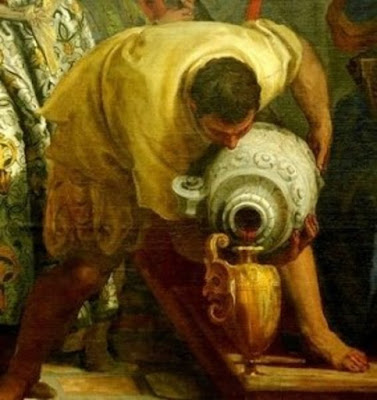
Philip counted the cost, and it was far above their ability to pay; but Andrew, the brother of Peter who brought Peter first to Christ, timidly commented on the five barley loaves and two fishes of a lad who was present with them. “But what are they among so many?” There is a tiny spark of faith in Andrew’s comment. There is not a great quantity, but there is SOME quantity available – Andrew remembers the six jugs of water turned to wine. There was no wine left, but there were six empty jugs in which water could be transformed into wine. In the hand of Christ, all things are possible. When our resources are the most scarce is the moment when the glory of God can be most profoundly demonstrated. Here is a lad who brought provender sufficient for himself, yet was willing, also, to share with such a multitude. That is the kind of compassion that God can turn to miraculous proportions.


"Make the men sit down." – 5,000 men, plus whatever number of women and children were in attendance. What do we learn from this positive command? When there is no hope in the arm of flesh to satisfy  our needs, we must depend upon the arm of God. Our own works and efforts cannot avail, so we sit down in faith as the Lord moves to resolve our dilemma. Another point here is that all things must be done in good order. If the Lord will work, we need to remain attentive and stay out of the way.

“And Jesus took the loaves; and when he had given thanks, he distributed to the disciples, and the disciples to them that were set down; and likewise of the fishes as much as they would.” The Lord always returned thanks to the Father. Now, He distributes the bread and fishes to the disciples for serving. The Lord could have personally shared the bread and fishes with the people directly, but He affords His ministers the opportunity to have a role in providing the Bread of Life to His people. Every person received their fill – as much as they wanted. God does not satisfy our needs in a half-hearted gesture – He fills wholly and completely.


"Gather up the fragments that remain, that nothing be lost." Men and women of faith are so richly blessed by God that they need not hoard the blessings. Their hearts become fountains of living water gushing forth into eternal life to all who will hear and receive. Twelve baskets of bread were gathered of the five loaves given by the lad after all had eaten. Truly, there will never be want of bread in the House of the Lord – even the twelve tribes of all Israel (those who have believed the promise made to Abraham of both Jew and Gentile) will be filed. How many loaves do you have, and how much can your sharing be multiplied?

I can of my own self do nothing – 27 January 2022, Anno Domini


I

  CAN of mine own self do nothing: as I hear, I judge: and my judgment is just; because I seek not mine own will, but the will of the Father which hath sent me. 31 If I bear witness of myself, my witness is not true. 32 There is another that beareth witness of me; and I know that the witness which he witnesseth of me is true. 33 Ye sent unto John, and he bare witness unto the truth. 34 But I receive not testimony from man: but these things I say, that ye might be saved. 35 He was a burning and a shining light: and ye were willing for a season to rejoice in his light. 36 But I have greater witness than that of John: for the works which the Father hath given me to finish, the same works that I do, bear witness of me, that the Father hath sent me. 37 And the Father himself, which hath sent me, hath borne witness of me. Ye have neither heard his voice at any time, nor seen his shape. 38 And ye have not his word abiding in you: for whom he hath sent, him ye believe not. 39 Search the scriptures; for in them ye think ye have eternal life: and they are they which testify of me. 40 And ye will not come to me, that ye might have life. 41 I receive not honour from men. 42 But I know you, that ye have not the love of God in you. 43 I am come in my Father’s name, and ye receive me not: if another shall come in his own name, him ye will receive. 44 How can ye believe, which receive honour one of another, and seek not the honour that cometh from God only? 45 Do not think that I will accuse you to the Father: there is one that accuseth you, even Moses, in whom ye trust. 46 For had ye believed Moses, ye would have believed me: for he wrote of me. 47 But if ye believe not his writings, how shall ye believe my words? (John 5:30-47)


            Can the elect of God do any good work apart from Christ? What a wonderful change would descend upon the Church if her people adhered to the opening principle of the above text made by our Lord. If, in all our thoughts, words, and deeds, we conformed to the will of the Father in their execution, would not our behaviors change to that of holiness and not a casual faith? As Christians, we are bound by that same principle. We can do nothing of worth apart from Christ working in and through us. Our good works are not ours, but His who has claimed us and redeemed us in a bloody sacrifice. Our ungodly works are all that we can lay claim to. Even our good works, performed outside bounds of grace, are wicked in the eyes of the Lord. An high look, and a proud heart, and the plowing of the wicked, is sin. (Proverbs 21:4)


            What a great thing is the measure of our Father’s love for us that makes possible our love for Him. The Church is the Bride of Christ. 25 Husbands, love your wives, even as Christ also loved the church, and gave himself for it; . . . So ought men to love their wives as their own bodies. He that loveth his wife loveth himself. (Ephesians 5:25, 28) There seems to be a very meaningful counsel to us in this passage. Note, there is no mention of the wife loving the husband. Why do you suppose it is so? I believe that the nature of a woman’s heart is to always return the kind of love that is sacrificial unto death. It is the very nature of the woman’s heart. It is also true, since Christ first loved us (the Church) we are destined to reciprocate that love as a faithful Bride. 


            God loved us long before the laying of the foundations of the world. We were deliberately placed in the hand of His only Begotten Son by grant and will of the Father – and we know that our Lord will not lose a single soul placed in His care. If we could only accept without reservation every word spoken by the Apostles, and discount our own frail powers of logic and reason, we would be very near the Gates of Splendor.  Jeus, in His last prayer, spoke these words: 6 I have manifested thy name unto the men which thou gavest me out of the world: thine they were, and thou gavest them me; and they have kept thy word. 7 Now they have known that all things whatsoever thou hast given me are of thee. 8 For I have given unto them the words which thou gavest me; and they have received them, and have known surely that I came out from thee, and they have believed that thou didst send me. 9 I pray for them: I pray not for the world, but for them which thou hast given me; for they are thine. 10 And all mine are thine, and thine are mine; and I am glorified in them. 11 And now I am no more in the world, but these are in the world, and I come to thee. Holy Father, keep through thine own name those whom thou hast given me, that they may be one, as we are. (John 17:6-11) This is consistent with the doctrine recovered by the Reformers at the founding of our Church.


XVII. Of Predestination and Election.


Predestination to Life is the everlasting purpose of God, whereby (before the foundations of the world were laid) he hath constantly decreed by his counsel secret to us, to deliver from curse and damnation those whom he hath chosen in Christ out of mankind, and to bring them by Christ to everlasting salvation, as vessels made to honour. Wherefore, they which be endued with so excellent a benefit of God be called according to God's purpose by his Spirit working in due season: they through Grace obey the calling: they be justified freely: they be made sons of God by adoption: they be made like the image of his only-begotten Son Jesus Christ: they walk religiously in good works, and at length, by God's mercy, they attain to everlasting felicity.As the godly consideration of Predestination, and our Election in Christ, is full of sweet, pleasant, and unspeakable comfort to godly persons, and such as feel in themselves the working of the Spirit of Christ, mortifying the works of the flesh, and their earthly members, and drawing up their mind to high and heavenly things, as well because it doth greatly establish and confirm their faith of eternal Salvation to be enjoyed through Christ, as because it doth fervently kindle their love towards God: So, for curious and carnal persons, lacking the Spirit of Christ, to have continually before their eyes the sentence of God's Predestination, is a most dangerous downfall, whereby the Devil doth thrust them either into desperation, or into wretchlessness of most unclean living, no less perilous than desperation.[1]


            If we accept the clear teachings of Christ and His Apostles, we can be certain of our security in Christ. Christ loses none the Father places in His hand.


[1] Excerpted from Article XVII, Thirty Nine Articles of Religion – English Reformation Church

Monday, January 24, 2022

A burning light to the Gentiles – 25 January 2022, Anno Domini


I

 WENT to Damascus with authority and commission from the chief priests, 13 At midday, O king, I saw in the way a light from heaven, above the brightness of the sun, shining round about me and them which journeyed with me. 14 And when we were all fallen to the earth, I heard a voice speaking unto me, and saying in the Hebrew tongue, Saul, Saul, why persecutest thou me? it is hard for thee to kick against the pricks.15 And I said, Who art thou, Lord? And he said, I am Jesus whom thou persecutest. 16 But rise, and stand upon thy feet: for I have appeared unto thee for this purpose, to make thee a minister and a witness both of these things which thou hast seen, and of those things in the which I will appear unto thee; 17 Delivering thee from the people, and from the Gentiles, unto whom now I send thee, 18 To open their eyes, and to turn them from darkness to light, and from the power of Satan unto God, that they may receive forgiveness of sins, and inheritance among them which are sanctified by faith that is in me. 19 Whereupon, O king Agrippa, I was not disobedient unto the heavenly vision: 20 But shewed first unto them of Damascus, and at Jerusalem, and throughout all the coasts of Judaea, and then to the Gentiles, that they should repent and turn to God, and do works meet for repentance. 21 For these causes the Jews caught me in the temple, and went about to kill me. 22 Having therefore obtained help of God, I continue unto this day, witnessing both to small and great, saying none other things than those which the prophets and Moses did say should come: 23 That Christ should suffer, and that he should be the first that should rise from the dead, and should shew light unto the people, and to the Gentiles. (Acts 26:12-23)


               There has never been such a Light as that which dawned on the world at the advent of our Lord Jesus Christ. He is the Light of the world, and we are His Light-Bearers with our marching orders to bear that Light to the far reaches of the globe. Our very best example, as Light Bearers of Christ, is exemplified in the person of St. Paul of Tarsus. Saul (later named, Paul, by the Lord) was born in what is today, Turkey, in the free city of Tarsus. He was raised in Jerusalem and was a citizen of Rome.


            Were we have served in judgment against Saul in his shameful life before meeting the Lord, we would have condemned him to the fires of Hell. Saul was a terror to the Church of Christ in his past life as a well-learned Pharisee. He was raised up a Pharisee of the highest order under prestigious Gamaliel. He was responsible for the putting to death, or incarceration, of many Christians. He led the Jewish rabble who stoned Stephen. What would WE say of such a one? We judge either by the spur of the moment or by past actions, but God judges for future purpose. God not only sees who we are at present, what we have been in the past, but also what we can become under His Holy purpose.


            The teaching of Paul was used to plant the seeds of the Gospel throughout the know world of his day. In fact, Paul’s thirteen Epistles (almost half of the books of the New Testament, had a tremendous impact on the great Continental and English great Reformers. 


Much of the Protestant Reformation was based on Paul's teaching that people are saved by grace, not works:8 For by grace are ye saved through faith; and that not of yourselves: it is the gift of God: 9 Not of works, lest any man should boast. (Eph 2:7-9) This truth gives us security and comfort in our salvation. We no longer try to adhere to a checklist of ‘rights and wrongs’ for our salvation. Our obedience to God is now driven by love that compels good works.


Paul was that burning light that bore the torch of Christ to many disparate lands of the known world. We read in Acts the self-description of Paul’s mission. At Antioch, Paul said: For so hath the Lord commanded us, saying, I have set thee to be a light of the Gentiles, that thou shouldest be for salvation unto the ends of the earth. 48 And when the Gentiles heard this, they were glad, and glorified the word of the Lord: and as many as were ordained to eternal life believed. 49 And the word of the Lord was published throughout all the region.  (Acts 13:47-49)


            Owing to the envy and malice of the unbelieving Jews, Paul was arrested and demanded his rights as a Roman citizen to appeal to Caesar. He was arraigned before King Agrippa and Festus to whom he witnessed to his calling and apostleship in Christ. 31 And when they were gone aside, they talked between themselves, saying, This man doeth nothing worthy of death or of bonds. 32 Then said Agrippa unto Festus, This man might have been set at liberty, if he had not appealed unto Caesar.  (Acts 26:31-32)


            Paul was later beheaded in Rome after many years of service, and expounding of Scripture in his Epistles. 

The empty bottle – 24 January 2022, Anno Domini


A

ND Abraham rose up early in the morning, and took bread, and a bottle of water, and gave it unto Hagar, putting it on her shoulder, and the child, and sent her away: and she departed, and wandered in the wilderness of Beersheba. 15 And the water was spent in the bottle, and she cast the child under one of the shrubs. 16 And she went, and sat her down over against him a good way off, as it were a bowshot: for she said, Let me not see the death of the child. And she sat over against him, and lift up her voice, and wept. 17 And God heard the voice of the lad; and the angel of God called to Hagar out of heaven, and said unto her, What aileth thee, Hagar? fear not; for God hath heard the voice of the lad where he is. 18 Arise, lift up the lad, and hold him in thine hand; for I will make him a great nation. 19 And God opened her eyes, and she saw a well of water; and she went, and filled the bottle with water, and gave the lad drink. 20 And God was with the lad; and he grew, and dwelt in the wilderness, and became an archer. 21 And he dwelt in the wilderness of Paran: and his mother took him a wife out of the land of Egypt.  (Gen 21:14-21)


            Poor Hagar, the mother of Ishmael, was sent off by Abraham with a modest provision of bread and water into the Wilderness of Beersheba. This was a result of a failure of faith by both Sarah and Abraham in the promises of God. Abraham & Sarah had been given the son of promise, Isaac, for whom Ishmael had only contempt. So, Hagar began her sad journey with her child in hand and on her shoulder a bottle of water. Hagar was forlorn of hope as she observed the small provision being depleted along her journey and knowing that there was not likely sufficient supply to see them through the Wilderness. 


            As Hagar approached the very middle of this Wilderness of Beersheba, her bottle gave out of water. Her child was tired and dying of thirst. What could a loving mother do? She placed Ishmael under a shrub and went an arrow’s shot away so that she could not witness the demise of her only son. She could not bear to hear the boy crying out to his mother in desperation for drink. Hagar wept bitterly and alone in the wilderness. But, there was One who heard the crying of the boy – God Almighty always hears the cries of his little ones. The angel of God opened Hagar’s eyes and she saw a well of water there. It had been there all along, but Hagar could not see for her tears. 


            The empty bottle of Hagar illustrates the vain works of man without the intervening grace and mercy of God. Many of the world face life with bottles that are filled with the false hope and provision of men, but it is the Bottle of God that provides the Water of Life that will forever quench our thirst.


            This past Sunday was the Third past Epiphany, and it, too, was about empty bottles. Our Lord was at a Marriage Feast in Cana of Galilee when the wine gave out. Upon the reminder of His mother, Mary, Jesus had the servants fill the six large jugs with water – to the brim. He thus instructed the servant to take the wine to the ruler of the feast for testing. “And he saith unto them, Draw out now, and bear unto the governor of the feast. And they bare it. 9  When the ruler of the feast had tasted the water that was made wine, and knew not whence it was: (but the servants which drew the water knew;) the governor of the feast called the bridegroom, 10 And saith unto him, Every man at the beginning doth set forth good wine; and when men have well drunk, then that which is worse: but thou hast kept the good wine until now.” (John 2:8-10) Where the Lord blesses our labors, there are no empty bottles.


            There may be one case in which an empty bottle may be a blessing – God’s Tear Bottle. “Thou tellest my wanderings: put thou my tears into thy bottle: are they not in thy book? When I cry unto thee, then shall mine enemies turn back: this I know; for God is for me. (Psalm 56:8-9)


If the Tear Bottle of God is filled with our tears, then our own tear bottles will be empty. On one occasion at Capernaum, our Lord entered the home of Simon the Pharisee and sat down to meat. “37 And, behold, a woman in the city, which was a sinner, when she knew that Jesus sat at meat in the Pharisee's house, brought an alabaster box of ointment, 38 And stood at his feet behind him weeping, and began to wash his feet with tears, and did wipe them with the hairs of her head, and kissed his feet, and anointed them with the ointment.” (Luke 7:37-38)


            It is likely that so many tears were needed to bathe the feet of another that the woman emptied her tear bottle with which she would be customarily buried at death. With Christ, she no longer needed a tear bottle, so, she gave all her tears to our Lord Jesus Christ to be kept in God’s Tear Bottle.


            The woman at Jacob’s Well came bearing her empty bottle seeking the vain water of the world. This represents her works without Christ. But she went away, leaving her empty bottle, for she had found the Water of Life that shall quench the thirst forever.

Sunday, January 23, 2022

AOC Sunday Report - Third Sunday after the Epiphany


Happy Third Sunday after the Epiphany!  The AOC Sunday Report can be downloaded RIGHT HERE!

We have great sermons today from Bishops Jerry and Roy, as well as Revs Jack and Bryan!  Each is quite different and quite good.  I enjoyed each of them and I am sure you will also.  Rev Jack's is available to view on video RIGHT HERE!

There are always a lot of people who need your prayer, the full prayer list is always RIGHT HERE, but I personally beg each of you to spend a little time in prayer.  Start with Tricia, Shamu, Jim, Lori, Laurie and work out from there.  Think how you would feel if you were on the list, those of you who are know how much prayer helps.

The first month of the year is almost gone, time is flying by.  Are you enjoying it?  Do you appreciate the love around you?  Are you part of the love and the solution or are you part of the problem.  Open your heart to the Holy Ghost and prepare to enjoy life.

The week ahead has potential, find it.

Godspeed,

Hap
Church of the Faithful Centurion
Descanso, California
United States of America

SEWRMON SUMMARY FOR 17TH SUNDAY AFTER TRINITY (Bishop Jerry Ogles)