Blog Archive

Monday, November 2, 2026

 THE FAMILY ALTAR

November 2.


"Speaking the truth in love". Eph. 4:15


Lutheran Christians have every reason to be courageous Chris-

tians. They know what they believe and why they believe. They

have God's Word and God's Word has them, as Luther so perti-

nently puts it. Because their faith is grounded on God's clear

Word and God's Word rules in their hearts, they are not tossed

to and fro and carried about with every wind of doctrine, by the

sleight of men and cunning craftiness, whereby so many are de-

ceived in these days of strife and dissension. They speak the truth

in love when their Roman Catholic neighbors may try to win them

for their church because they believe that outside of the Pope's

church there is no salvation. In all love Lutheran Christians will

show these neighbors how grossly they err and that the one true,

saving Church is the Holy Christian Church in which the Savior,

Jesus Christ, is the head Bishop. When they are criticized in these

unionistic days by their Protestant friends for their strict adher-

ence to God's Word and Luther's doctrine pure and asked to join

with them in forming one big united church including all denom-

inations, Lutheran Christians will show these friends how im-

possible and wrong that would be for them; for they would have

to sacrifice clearly revealed truths of Christ's saving Word and thus

prove faithless stewards of His sacred trust. They will show these

misguided friends that the union among His disciples for which

Christ prays His heavenly Father, John 17, 21, consists not in an

outward, visible organization, but in the unity of spirit, in the

oneness of faith in Him and His revealed Word. Only so long as

they continue in Christ's Word are they His disciples indeed.

(John 8, 31.)

Daily Readings in Life of Christ - J.R. Miller (1890)

November 2. The Comforter

"Nevertheless I tell you the truth; It is expedient for you that I go away: for if I go not away, the Comforter will not come unto you; but if I depart, I will send him unto you." John 16:7

Why did the coming of the Comforter depend on Christ's going away? We may say, for one thing, that the Comforter could not come — until the great offering for sin had been made. The Father sent the Son to be the atoning sacrifice for sins. Without shedding of blood — there could be no remission of sins. There was, therefore, no redemption to be offered and applied — until Jesus had made His great sacrifice. It was necessary, therefore, that He should go away and should die — before the Comforter could come. The precious alabaster box of Christ's humanity must be broken open — in order that the sacred ointment of His most blessed life might be poured out on the dead world.

It was necessary, also, that Christ should return to the Father as the Son of man, the representative of humanity, and be received into the Father's bosom as such. "Humanity was to ascend to Heaven — before the Spirit could be sent to humanity on earth." Christ also says, that He will send the Comforter. He could not do this until He had returned to His glory and been exalted, in His humanity, to His throne of power.

These are hints of the reasons why Jesus had to go away before the Comforter could come. We live now under the blessed reign of the Holy Spirit. Sometimes we wish we had lived in the time of Christ's human presence in this world, and look back on the period of the incarnation as earth's brightest and most glorious days; but really we have far richer privileges than those had, who knew Christ in the flesh. We have the same blessed Presence that they had, only without the limitations of flesh. Christ is now to millions everywhere, even far more than He was then to a few favored ones. 

Sunday, November 1, 2026

 Longfellow's Song - 


"We cannot tell the precise moment when friendship is formed. As in filling a vessel drop by drop, there is at last a drop which makes it run over; so in a series of kindnesses there is at last one which makes the heart run over."

SAMUEL JOHNSON


 NOTE: Samuel Johnson (18 September 1709 – 13 December 1784), often called Dr Johnson, was an English writer &Cleric.

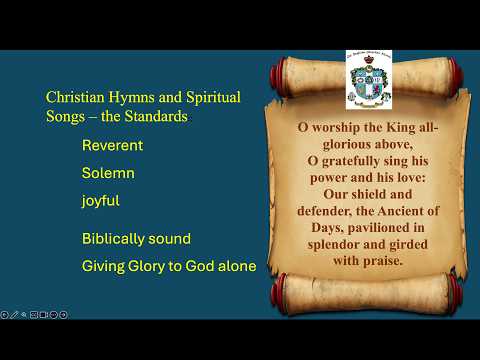
Standards of Hymn Singing